There are a number of 'growth areas' for housing planned around Cambridge. The Southern Fringe around Trumpington Village has got furthest through the planning process, but plans are now also progressing for the North West of the city, including the NIAB site.
Its the opposite side of the City to Coleridge, but the local authorities have agreed to the establishment of the North West Cambridge Community Forum, which will be set up to discuss a wide range of issues that are of relevance to the whole of the North West Cambridge quadrant. Membership will include key community stakeholders, local authority officers, councillors and partner organisations.
The first Open Community Forum Event will be held on 19th June at the Meadows Centre, 1 St Catharine’s Road and will be open to all members of the public. Local authority officers will be in attendance, as well as developers, and this event is seen as the beginning of the longer term engagement process with local communities.
Sunday, June 6, 2010

Friday, June 4, 2010
Blowing a Raspberry
It was disappointing news to many, including myself, that the police decided to 'cancel' this weekend's planned Strawberry Fair. Yes, it isn't everyone's idea of fun, but for many people in Cambridge and elsewhere it is, and the police could (and should) have concentrated on those causing trouble, and leave the vast majority who like the festival and the music to enjoy their day in sun.
Instead, they decided to 'cancel' the event by withdrawing their support. The City Council didn't help either by changing the licensing arrangements this year. The outcome was that the strawberry fair organising committee concluded they couldn't continue with this year's event as planned.
Not surprisingly in today's world of social networking sites and the like, an alternative event is now planned for the common. The reaction of the authorities to this says a lot about how the police and government view their role at the moment. Their view seems to be that if a group of people want to do something, it is up to the authorities to graciously grant us their permission, and if people aren't prepared to concede to every bit of regulatory control on the grounds of health and safety or whatever else the government thinks is good for us - which in itself is a constantly moving target - the authorities will just say no and think that is reasonable. The City Council have been in emergency planning mode - I couldn't tell you much about what precautions they have taken (for some reason I wasn't invited to the Councillor's briefing - UPDATE - it appears I was invited but only using my Council email address, which it turns out randomly stopped forwarding emails to me, so I didn't know about the invitation - apologies to those concerned for suggesting this was intentional - I give up completely on the Council's email system - I am now telling everyone to only use my personal address!). The police on the other hand were reported in the CEN as saying: 'Riot police will be on standby at an illegal gathering to replace Strawberry Fair' (my emphasis).
A letter in today's Cambridge Evening News makes the point I was thinking reading the CEN report: 'Since when was picknicking on common land illegal? What precise law are we breaking?'
The authorities clearly have a duty to protect public safety, and plan ahead where there are potential threats, but this whole episode illustrates the extent to which the police mindset is still very much in authoritarian New Labour mode - we don't like something, we'll stop it no matter what. My personal view is that as long a people behave responsibly and in accordance with the law, the police and authorities should be there to actively support them and protect them from those who don't behave in accordance with the law or with due responsibility for those around them. They can't be bothered to enforce the law in really very simple situations like cyclists riding at night without lights, or cars parked in mandatory cycle lanes - you would at least thought that they could police events like Strawberry Fair by concentrating on the small minority of law-breakers, rather than stopping everyone's fun.
Personally I don't plan to enjoy the sunshine on Midsummer Common tomorrow with friends, but I hope if lots of people do make that choice, they have a good time, but also think about the neighbouring residents and be responsible. If people do cause trouble, the police should focus on the troublemakers, and remember that they are partly responsible for the situation by regulating out of existence the formal organisation for the Fair - leaving behind an event over which they have much less control.
Instead, they decided to 'cancel' the event by withdrawing their support. The City Council didn't help either by changing the licensing arrangements this year. The outcome was that the strawberry fair organising committee concluded they couldn't continue with this year's event as planned.
Not surprisingly in today's world of social networking sites and the like, an alternative event is now planned for the common. The reaction of the authorities to this says a lot about how the police and government view their role at the moment. Their view seems to be that if a group of people want to do something, it is up to the authorities to graciously grant us their permission, and if people aren't prepared to concede to every bit of regulatory control on the grounds of health and safety or whatever else the government thinks is good for us - which in itself is a constantly moving target - the authorities will just say no and think that is reasonable. The City Council have been in emergency planning mode - I couldn't tell you much about what precautions they have taken (
A letter in today's Cambridge Evening News makes the point I was thinking reading the CEN report: 'Since when was picknicking on common land illegal? What precise law are we breaking?'
The authorities clearly have a duty to protect public safety, and plan ahead where there are potential threats, but this whole episode illustrates the extent to which the police mindset is still very much in authoritarian New Labour mode - we don't like something, we'll stop it no matter what. My personal view is that as long a people behave responsibly and in accordance with the law, the police and authorities should be there to actively support them and protect them from those who don't behave in accordance with the law or with due responsibility for those around them. They can't be bothered to enforce the law in really very simple situations like cyclists riding at night without lights, or cars parked in mandatory cycle lanes - you would at least thought that they could police events like Strawberry Fair by concentrating on the small minority of law-breakers, rather than stopping everyone's fun.
Personally I don't plan to enjoy the sunshine on Midsummer Common tomorrow with friends, but I hope if lots of people do make that choice, they have a good time, but also think about the neighbouring residents and be responsible. If people do cause trouble, the police should focus on the troublemakers, and remember that they are partly responsible for the situation by regulating out of existence the formal organisation for the Fair - leaving behind an event over which they have much less control.
Tuesday, May 25, 2010
Councillors meet Network Rail
Last night at a well attended meeting, three Network Rail representatives (covering commercial development and project management) talked to Councillors and Council officers about their plans for Cambridge Station.
The good news is that Network rail (or rather the government via network rail) is investing £17m in a new Island platform for Cambridge station - the main motivation being to support 12 carriage trains to help relieve overcrowding on the routes to London.
The main elements of the plan are to remove two of the underused lines at the station and to create a new island platform, approx 250m long and 9m wide in their place, with a track and platform on either side (to be called platforms 7 and 8). They are also planning a new footbridge to the island, from just north of the current station building (this seems to be the only place they can make it work). As well as supporting longer trains, the new platform will reduce problems with manoevering trains around the station, so could support more frequent services in future.
The plans could move forward quite quickly - Network Rail intend to seek planning permission next month - they don't usually need permission to develop on railway land, but do in this case as the station is a listed building. Construction would take 5-6 months next year - with small numbers of closures to the line hopefully coinciding with other engineering works. The new platform is planned to open on 12th December 2011, to coincide with the new winter timetable.
Less good news is that Network Rail really don't seem to understand just how many cycles use Cambridge station. We are in a unique situation nationally in terms of the high levels of cycle usage in the city, and failure to support journeys involving cycling and rail adequately (through lack of cycle parking and lack of support for bikes on trains) is holding back further takeup of cycling. If Network Rail doesn't get this right and lots of people go back to using their cars to get to the station, all commuters would suffer from increased congestion and longer journey times around the city.
Network Rail admitted they were using standard models for passenger movements through the station (to identify where the 'pinch points' like the booking office will be as passenger numbers increase), without taking specific account of the high levels of bike movements at Cambridge station. Their proposed footbridge is also a standard modular design that would require bikes to be carried up steps or put into small lifts. Along with other Councillors, I made the point that the new footbridge would need to be designed specifically to cope with high volumes of bikes and make it easy for people to cross the line with their bike. They have promised to let us have more details about their modelling of passenger movements for use of the new platform, and will have been left in no doubt that they need to rethink the footbridge. Councillors also urged Network Rail to work on this issue with Cambridge Cycling Campaign. It would be interesting to know how stations in places like Holland are setup to support cyclists...
Another topic of discussion was how a new entrance to the station could be created from the Coleridge side of the station. I support access to the station from this part of Coleridge, as long as it is mainly for pedestrians and cyclists - it would clearly need to be accompanied by some measures to stop commuter parking.
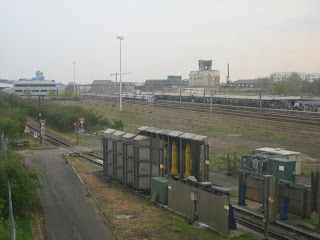
The area of land east of station is currently underused - mostly for the train washer, and the rail authorities are working on a longer term plan to redevelop this area all the way up to Mill Road. I would like to see a new Eastern access earlier than waiting for complete redevelopment of the area, but there are two problems - getting across the line next to the new platform 8, and the train washer (which apparently could cost over £1m to move elsewhere!). Hopefully network rail are going to think about possible solutions to this.
Finally, Coleridge Conservatives have been calling for much better communication from Network Rail about their plans for some time - it has taken a long time from when I first started asking Network Rail for a meeting for this meeting to be setup. I hope that in future they can be much more proactive in engaging both with locally elected representatives and the wider public about their plans to develop the railway network in Cambridge. I would like to see a new station at Chesterton, and the Chisholm Trail cycle route taken forwards. If the local Councils could find a way to raise funding for projects such as these (perhaps from existing developer contributions for transport), combined with funding from other sources, e.g. the government or train operating companies, these projects could happen earlier and issues like cycling facilities considered much earlier in the design process - all of this will require better channels of communication between all relevant groups, so hopefully yesterdays meeting was just the beginning.
The good news is that Network rail (or rather the government via network rail) is investing £17m in a new Island platform for Cambridge station - the main motivation being to support 12 carriage trains to help relieve overcrowding on the routes to London.
The main elements of the plan are to remove two of the underused lines at the station and to create a new island platform, approx 250m long and 9m wide in their place, with a track and platform on either side (to be called platforms 7 and 8). They are also planning a new footbridge to the island, from just north of the current station building (this seems to be the only place they can make it work). As well as supporting longer trains, the new platform will reduce problems with manoevering trains around the station, so could support more frequent services in future.
The plans could move forward quite quickly - Network Rail intend to seek planning permission next month - they don't usually need permission to develop on railway land, but do in this case as the station is a listed building. Construction would take 5-6 months next year - with small numbers of closures to the line hopefully coinciding with other engineering works. The new platform is planned to open on 12th December 2011, to coincide with the new winter timetable.
Less good news is that Network Rail really don't seem to understand just how many cycles use Cambridge station. We are in a unique situation nationally in terms of the high levels of cycle usage in the city, and failure to support journeys involving cycling and rail adequately (through lack of cycle parking and lack of support for bikes on trains) is holding back further takeup of cycling. If Network Rail doesn't get this right and lots of people go back to using their cars to get to the station, all commuters would suffer from increased congestion and longer journey times around the city.
Network Rail admitted they were using standard models for passenger movements through the station (to identify where the 'pinch points' like the booking office will be as passenger numbers increase), without taking specific account of the high levels of bike movements at Cambridge station. Their proposed footbridge is also a standard modular design that would require bikes to be carried up steps or put into small lifts. Along with other Councillors, I made the point that the new footbridge would need to be designed specifically to cope with high volumes of bikes and make it easy for people to cross the line with their bike. They have promised to let us have more details about their modelling of passenger movements for use of the new platform, and will have been left in no doubt that they need to rethink the footbridge. Councillors also urged Network Rail to work on this issue with Cambridge Cycling Campaign. It would be interesting to know how stations in places like Holland are setup to support cyclists...
Another topic of discussion was how a new entrance to the station could be created from the Coleridge side of the station. I support access to the station from this part of Coleridge, as long as it is mainly for pedestrians and cyclists - it would clearly need to be accompanied by some measures to stop commuter parking.

The area of land east of station is currently underused - mostly for the train washer, and the rail authorities are working on a longer term plan to redevelop this area all the way up to Mill Road. I would like to see a new Eastern access earlier than waiting for complete redevelopment of the area, but there are two problems - getting across the line next to the new platform 8, and the train washer (which apparently could cost over £1m to move elsewhere!). Hopefully network rail are going to think about possible solutions to this.
Finally, Coleridge Conservatives have been calling for much better communication from Network Rail about their plans for some time - it has taken a long time from when I first started asking Network Rail for a meeting for this meeting to be setup. I hope that in future they can be much more proactive in engaging both with locally elected representatives and the wider public about their plans to develop the railway network in Cambridge. I would like to see a new station at Chesterton, and the Chisholm Trail cycle route taken forwards. If the local Councils could find a way to raise funding for projects such as these (perhaps from existing developer contributions for transport), combined with funding from other sources, e.g. the government or train operating companies, these projects could happen earlier and issues like cycling facilities considered much earlier in the design process - all of this will require better channels of communication between all relevant groups, so hopefully yesterdays meeting was just the beginning.
Thursday, May 20, 2010
Coallition Deal Published
More details of the Conservatives-Lib Dem coalition deal have been published this morning, and it looks like many of the best bits of the Conservatives localism agenda will actually happen - with the following commitments from the coalition:
- We will promote the radical devolution of power and greater financial autonomy to local government and community groups. This will include a review of local government finance.
- We will rapidly abolish Regional Spatial Strategies and return decision-making powers on housing and planning to local councils, including giving councils new powers to stop ‘garden grabbing’.
- We will give councils a general power of competence.
- We will allow councils to return to the committee system, should they wish to.
- We will abolish the Standards Board regime.
- We will implement the Sustainable Communities Act, so that citizens know how taxpayers’ money is spent in their area and have a greater say over how it is spent.
- We will freeze Council Tax in England for at least one year, and seek to freeze it for a further year, in partnership with local authorities.
- We will cut local government inspection and abolish the Comprehensive Area Assessment.
Wednesday, May 19, 2010
Good news on Resurfacing
Good news from the County Council! Cherry Hinton Road is set to be resurfaced from Perne Rd to Cherry Hinton. This has been one of Coleridge Conservatives long standing requests for action to improve the road surfacing, and we welcome this news (although there are some sections nearer Hills Road that also could do with attention).
The County Council adds: 'It is anticipated the programme of work will commence mid June and will take approximately 6 weeks to complete. As the process is totally weather reliant it is impossible at this stage to give precise dates for each site. However, notices to inform road users of the works will be displayed at each location at least seven days before any work is undertaken.'
The County Council adds: 'It is anticipated the programme of work will commence mid June and will take approximately 6 weeks to complete. As the process is totally weather reliant it is impossible at this stage to give precise dates for each site. However, notices to inform road users of the works will be displayed at each location at least seven days before any work is undertaken.'
Saturday, May 15, 2010
Fix the Swings!
The swings on the Neville Road recreation ground have been vandalised. When I first reported the problem over a month ago, only two of the swings had been removed:

Now all of them have gone - apparently removed by someone with bolt cutters. The Council have assured me they can be replaced relatively quickly, but one aspect of the Council's response to this problem does worry me - they don't seem to have reported the criminal damage to the police and obtained a crime number.
When I follow up problems like this with the police, the usual response I get back is that they haven't had any reports so don't think there is a problem. I always encourage local residents to report all incidents of crime or anti-social behaviour (even if it frequently doesn't look like anything is being done in response to these reports...), so it is particularly disappointing that the Council itself doesn't seem to be following this advice. I hope incidents like this are rare, but when they do happen, I hope the Council will in future not just spend taxpayers money fixing the problem without reporting it to the police to investigate.
Friday, May 14, 2010
Where all the money goes - part 92
I was emailed details last week for a seminar being run by LGIU, the local government information unit, cost £250+VAT or £150+VAT for member organisations (i.e. tax payer funded local authorities). The title - 'Petitions – the new duty'. It goes on:
I've no idea if this is going to be included in the strong localism agenda of the new government, but I suggest an alternative model:
Genuinely empower local Councils and local Councillors to decide what happens locally
If residents aren't happy, they can contact their Councillors, email them, petition them or use any obvious method to make their view known.
If they aren't happy with the response from their Councillors, they dump them out at the next election and replace them with Councillors that will respond to their concerns.
And we scrap the central targets, duties and controls, scrap the civil servants dreaming up these regulations, scrap the taxpayer funded courses to teach Councils about them and use the money saved to help pay off the enormous budget deficit. Efficiency saving or cuts to vital front line services? I know which category I would put this in - but I dare say Labour will still be claiming it is impossible to reduce the cost of government at all without cutting 'vital front line services'
In other words, the (thankfully now deceased) former government has discovered that people don't much like the ability of local councils to respond to their concerns, so instead of tackling the real problem - the way in which local councils are dictated to in minute detail by central government, they conclude it must be down to how local council's 'engage' their communities. People don't like what is happening, so they put together a petition. They don't like the response to the petition (usually because the Council's hand are tied), so the government placed a duty on local Councils to respond to petitions in a certain way - and as taxpayers we now all fund the training courses to teach councils how to do it.The government has produced its statutory guidance on the new duty for councils to respond to petitions. It comes into force on 15 June 2010, and the e-petitions requirements come into force on 15 December 2010.The statutory guidance requires all councils to revise their handling of petitions to ensure that they meet the new duty.This seminar will focus on key issues that authorities will need to consider in implementing the new duty and in designing and developing a petitions scheme:Involving elected membersHow petitions fit within the council’s engagement and involvement strategy and its engagement processesImplications for overview and scrutinyImplications for partners and co-operationImplications for senior officersThe DCLG model schemeSetting thresholdsE-petitionsSharing knowledge and experience with each other delegates will be invited to consider how petitions and e-petitions can work.
I've no idea if this is going to be included in the strong localism agenda of the new government, but I suggest an alternative model:
Genuinely empower local Councils and local Councillors to decide what happens locally
If residents aren't happy, they can contact their Councillors, email them, petition them or use any obvious method to make their view known.
If they aren't happy with the response from their Councillors, they dump them out at the next election and replace them with Councillors that will respond to their concerns.
And we scrap the central targets, duties and controls, scrap the civil servants dreaming up these regulations, scrap the taxpayer funded courses to teach Councils about them and use the money saved to help pay off the enormous budget deficit. Efficiency saving or cuts to vital front line services? I know which category I would put this in - but I dare say Labour will still be claiming it is impossible to reduce the cost of government at all without cutting 'vital front line services'
Subscribe to:
Posts (Atom)
